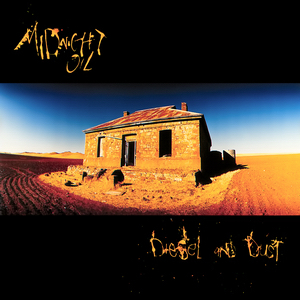
 Celsius, of course. Taken from the famous Midnight Oil song “Beds are Burning” a huge hit back in 1987. The Oils were a rabble rousing, politically progressive rock band that became the face of Australia for many people around the world. After starting as a surf rock band in Sydney back in 1976 they had some success at home, but when they switched to a simpler, more melodic style and addressed head on the injustices suffered by the aboriginal “First Nations” of Australia they had their greatest success globally. “Holden” was the main and iconic Australian car manufacturer until 2020 with vintage models from the 50s through the 70s becoming highly prized. Even now, out in the bush, you can still come across a rusting Holden.
 On this trip we’re keeping close to the Southern Coast of Australia and not spending time in the Northern Territory, Queensland or the Northern part of Western Australia. Consequently, we saw very few indigenous people on this trip with most of that population having been moved North or, at least, way out into the Outback.
 45 degrees Celsius is about 113F so, hot. Yep, Australia is a hot country but, luckily, in the South of the country it’s Spring with corresponding mild temperatures and periodic rain. Not so in the Summer: On this trip we went to Margaret River in WA where the locals were sweating bullets about the coming fire season and, now, we’re arriving at Kangaroo Island, South Australia which is still recovering from catastrophic fires in 2019-2020. The big fire was started by lightning near the western coast in the Flinders Chase National Park and spread across nearly half the island, bearing in mind that this island is 100 miles long and 35 miles long.
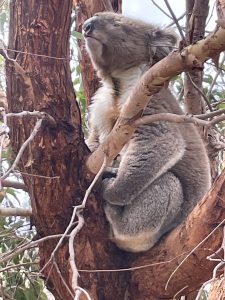 Per a ranger at the Hanson Bay Wildlife Sanctuary there used to be 60,000 koalas, now there are 16,000. It was a disaster for the ages, but it was amazing to see how strongly the island has rebounded in the five years since then. Many of the large eucalyptus trees survived and the smaller trees and scrubs are bouncing back. Although there was a huge loss of fauna, and livestock for that matter, most of the animals have rebounded except for a few niche, endangered species that, likely, did not make it through.
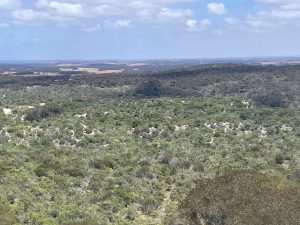 The ferry from the mainland arrives at Penneshaw, but we’re staying in Kingscote about 40 minutes away. The island is big and, unless you’re on a packaged tour an automobile is essential, and we ponied up to bring a rental car on the ferry. It’s not high season so, while crossing the island, it’s not often you see another vehicle outside of the settlements. However, there are many marsupials to watch out for, especially if you’re driving after dark, and I wouldn’t advise doing so outside of town. Sad to say, the roads are littered with the carcasses of wallabies, birds and wombats. Much of the wildlife here is nocturnal so, if you’re not up for staying up all night, early morning and near dusk are your best chances to see the local animals.
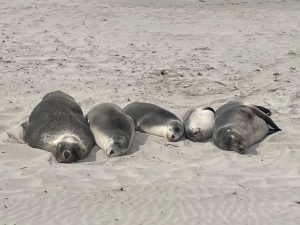 An exception to this are the marine mammals such as the sea lions at Seal Bay Conservation Park on the South side of the island. Although there are viewing platforms above, it’s absolutely worth paying for the guided beach tour to see the colony up close. Actually, the sea lions have several large bays that are completely protected from humans but many of them still choose to rest on the beach with the guided tours. They spend all their active time out at sea feeding, only returning to the bay to rest up, so the rangers make sure we don’t disturb them. In Winter, they retreat from the beach up into the bushes on the hillside where they’ve fashioned the shrubs into seal condos to protect themselves from the cold wind coming off the Southern sea.
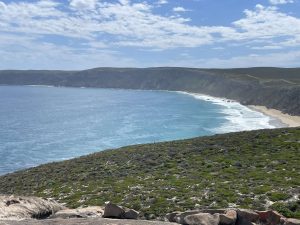
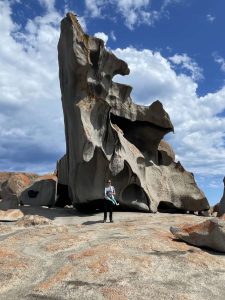 The big national park on the island is Flinders Chase and a day trip is obligatory, about an hour’s drive from our Airbnb. It’s hard to believe the park was devastated by fire in 2020 as recovery is in full swing. There’s a fancy new visitor center and all the infrastructure has been repaired, though signs of the fire are everywhere if you look closely. Most of the tourists, and we were no exception, head to the west end of the park to see the “Remarkable Rocks”, Admiralty Arch, a colony of long-nosed fur seals and, generally, stunning marine views.
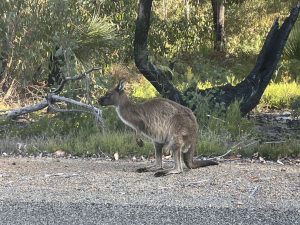 As you drive through the park you can see many kangaroos, wallabies and the endemic Cape Barren Goose and, on our hikes, we come across echidnas, goanna lizards, koalas and innumerable birds but the elusive platypus is more difficult to find. We give it a go on the Platypus Waterholes Walk but, even with patience and stealth in the later afternoon we don’t have any luck.
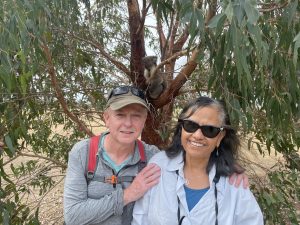
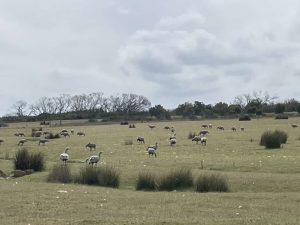 The weather has been up and down but it’s a fine day when we visit the Hanson Bay Wildlife Sanctuary near the Eastern entrance to Flinders Chase. This place was completely destroyed in the 2020 fire, and they did not rebuild the visitors center, so it’s a little strange when we arrive to a deserted parking lot. The volunteer guide does show up, however, and it’s just us and one other couple on the tour. This place specializes in koalas or, I should say, koalas specialize in this place. After the fire, it was all gone but, as the area recovered the koalas returned on their own, albeit in lower numbers than before. For better or worse, koalas are not bothered by people, mostly because they’re usually way up in a gum tree, but at Hanson Bay they really don’t give a hoot and, with a guide, we get close up and personal with some of the locals. Even with the impact of the fire, KI remains a koala stronghold. It’s a surprise to hear the male’s guttural groans, likely, in search of a mate. Koala love is surprisingly rough and ready with the male biting the female’s neck from behind in preparation for mating. The female’s subsequent screaming lets us know that she is not enjoying the experience. Still, the females get the last laugh as the male koala lifetime is significantly shorter than the female’s, mainly because the males beat the crap out of each other on a regular basis. The joys of nature!
 Aside from flora, fauna and scenery KI also does a good line in artisanal alcohol, wool, honey and beauty products. Wine tasting is tricky however, as the places are spread out and drink/drive laws in Australia are very strict. Funnily enough, I’m not sure there are many (any?) police actually stationed permanently on the island as during our 5 days there we saw, maybe, one car and that may have actually been a fire ranger. It’s on KI, while we’re waiting for our pizza to be ready in Kingscote that we learn of the election result in the US. Strangely, we were also in Tasmania, Australia In 2016 when this happened the first time, I guess the universe is telling us don’t do back to Australia again, at least not during an election.
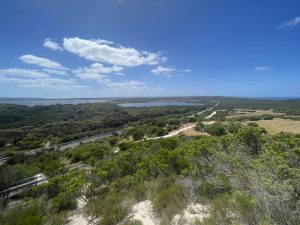 On the last day, on the way back to the ferry in Penneshaw, we stop off at Prospect Hill overlooking Pelican Bay. There’s a new metal staircase but it’s still a brutal climb to the top which is the highest point on KI. This is where Matthew Flinders, who apparently got around a lot, determined his bearings in 1802. Flinders was a Royal Navy navigator and cartographer who first circumnavigated mainland Australia and also came up with the name “Australia” thinking it easier on the ear than previous names such as Terra Australis. Anyhoo, a great view of Pelican Lagoon and Pennington Bay but some nasty leg cramps afterwards. (Maybe the pitch of the metal stairs being longer than usual?).
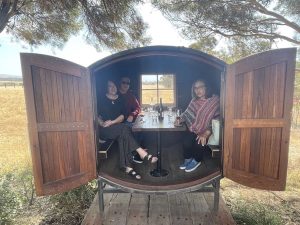 The ferry drops us on at Cape Jervis on the mainland and we head up to Seaford on the St Vincent Gulf to meet up with my niece Angela and her husband Mick for a pleasant weekend of wine tasting, shooting the breeze and a quick investigation of Adelaide to see the Chihuly exhibition at the Botanic Gardens.
The Shiraz of McClaren Vale is fine indeed but, with our flight to Sydney the next day we can’t go crazy and buy much to take with us. No shortage of wine in Australia for sure, it’s taking a heavy toll on our bodies as the weeks go by. (It’s a hard life). No peace for the wicked as we’ll be heading out immediately from Sydney airport to briefly visit the famous Blue Mountains of New South Wales.


Leave a Reply