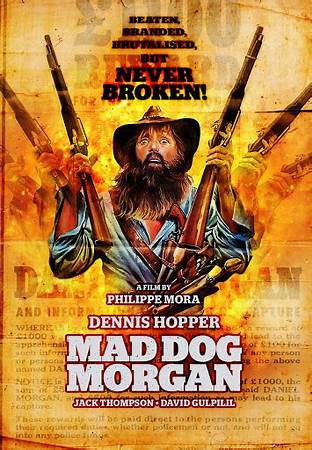
 The title is from “Billabong Valley” a song from King Gizzard and the Lizard Wizard, a band out of Melbourne, Victoria and, perhaps, the best live rock band on the planet at this time – If that counts for anything these days. I also see now that “Mad Dog Morgan” was a 1976 movie starring Dennis Hopper set in the outback with Hopper as “mad” Daniel Morgan. Need to check that out!
A billabong is a small pond or water hole in the outback and many of you likely remember the lyric from “Waltzing Matilda” where a jolly swagman sat by said billabong under the shade of a coolibah tree, as you do. As it did for the swagman (itinerant worker) in Waltzing Matilda, things did not end well for Mad Dog Morgan “Tied naked to the trees, killed so gruesomely”. Life was hard in the outback of the 19th century.
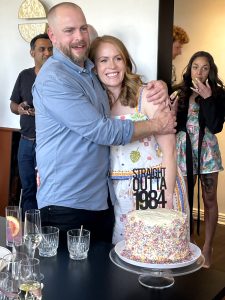 Life is a lot easier in the Melbourne of the 21st Century and we’re here to meetup with my nephew Rowan, his partner El and their family and, after that, on head out on the Great Ocean Road, which runs West from Melbourne a good deal of the way to Adelaide, which is nearly 600 miles if you stick to the coast. Row lives in the inner suburb of Balaclava just SE of the city center, a place not dissimilar to what we have on the East side of Portland. Even though its twice as large, Melbourne is often compared to Portland due to its hipster quotient, progressive attitudes, good food, drink and music, while still remaining rough around the edges. Great public transportation as well with suburban rail and trams being the mainstays.
Due to privacy concerns, I usually don’t include much family details in these posts but did want to say that we were there for Row’s 40th birthday party, and also to commemorate what would have been my other nephew’s, Karl’s 50th. Karl passed away in late 2019 after a 15-year battle with a brain tumor. He was a unique guy, and the world is a lesser place for his absence: I’m glad we were able to join at this celebration and commemoration.
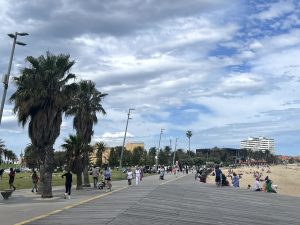 Balaclava is adjacent to St Kilda and the beachfront of the Port Phillip Bay, where there’s quite a scene going on at the waterfront promenade. Definitely a place to hang out and be seen parading your designer dog or displaying your physique while jogging before picking up a “flat white”. If the term “flat white” hasn’t reached your neighborhood yet, it is an Australian and New Zealand espresso standby comprising 1.5oz espresso, 4-5oz of steamed milk and 0.5oz micro foam. Definitely, a stronger coffee flavor than a latte, smooth without being creamy. If I didn’t already mention it, the coffee culture down under is insanely geeky, putting even Portland and Seattle in the (Calliandra) shade.
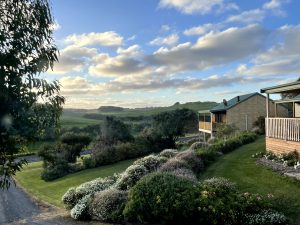 After a fun weekend we pick up a rental car and head off West towards the Great Ocean Rd, with our destination being Port Campbell. After a slog through Melbourne’s extended suburbs, we finally hit the ocean road at Torquay, the original home of Aussie surfing. No time to stop there though and we have to detour on the inland highway in order to reach our destination before nightfall. Port Campbell is tiny with a single main street and we’re staying outside of town in a cabin in the beautiful surroundings of a hobby farm.
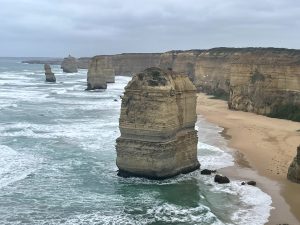 Our first priority is to check out the Port Campbell National Park which stretches along the coast just East of town. This is another world-renowned bucket list location due to the limestone and sandstone rock formations including the famous “12 Apostles”. The apostles are limestone stacks rising from the water close to shore that are the remnants of land formed 20 million years ago that has been eroded and separated from the mainland. Funnily enough, there never were 12, only 9, and one of those has completely disappeared. They were originally named “Sow and Pigs” but someone thought 12 Apostles had a better ring to it, though there’s still a brewpub in town called “Sow and Piglets”. Bring back the Pig!
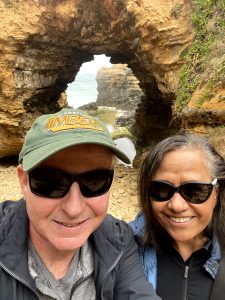 The Sow and Piglets are not the only rock formation and many others like “London Bridge”, “Loch Ard Gorge” and “The Grotto” are all worth seeing, but go soon as they are all steadily crumbling into the waves. Plus, when you do go, stay nearby and get out there early on a weekday as, by Noon, the tour buses from Melbourne arrive and the crowds will definitely harsh your buzz.
The “Shipwreck Coast” extends between Port Campbell and Port Fairy and has claimed about 700 ships over the years. We visited Loch Ard Gorge where the eponymous ship went down in 1878 with all hands lost except for Tom Pearce, a crew member and Eva Carmichael a passenger. Tom swam back out to rescue Eva who was hanging onto a chicken coop. Contrary to legend, they didn’t marry, and Eva returned to Ireland while Tom remained a sailor unfortunately dying at the young age of 49.
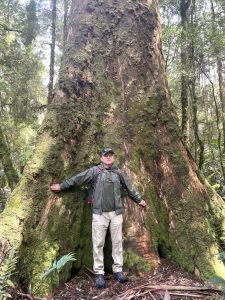 Another destination accessible from Port Campbell is the Cape Otway National Park which, in addition to unspoiled coast, also has dense rainforest. This is another Aussie ecosystem with enormous trees, ferns and big waterfalls. We do the Triplet Falls loop, and the Little Aire Falls Walk and see only a few people the whole time. Although Australia is mostly arid, based on surface area, it’s amazing how huge the forests are in SW Australia and the Southern sections of Victoria and New South Wales. We see signs warning that yabby traps are harming the elusive platypuses. A “yabby” is a large freshwater crayfish which are considered a delicacy. If you’re up for a more challenging stroll the “Great Ocean Walk” goes for 56 miles from Apollo Bay to the 12 Apostles.
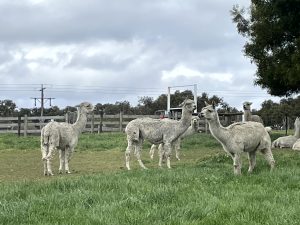
In addition to pristine nature the area also has much in the way of fun stops related to food, drink and arts & crafts. They market it as the “12 Apostles Food Artisans Gournet Trail”. Gorge Chocolates in Corriemungle is on our way home but what makes it memorable are the llamas which, in addition to hanging around outside the chocolate shop, also feature heavily in the confectionery designs.
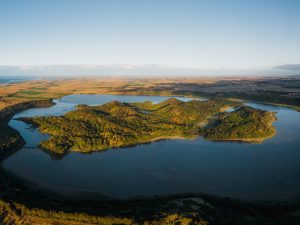 The following day we head West along the coast just past Warrnambool to Tower Hill Wildlife Reserve which is situated in a volcanic crater created 30,000 years ago. In the center of the huge crater is a heavily vegetated island, presumably formed from more recent smaller eruptions, surrounded by water. Somewhat similar to Crater Lake in Oregon, USA but not as high and with more island area and less water expanse. Tower Hill was named as Victoria’s first National Park in 1892 but was not looked after well and much of it was used for farming and quarrying. Finally, in 1961 it was taken over as a nature reserve, restoration began and, in addition to wholescale native replanting, indigenous animals of all types were reintroduced. They’re still there today; it is a great place to see koalas, echidnas, emus, wallabies, possums and a big variety of birds.
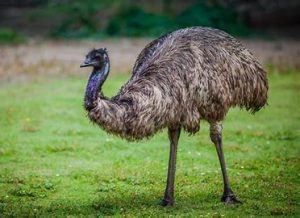 It’s a pocket wilderness in a dramatic setting and highly recommended if you’re anywhere nearby. Tower Hill is run in conjunction with the Worn Gundidj Aboriginal Cooperative and there’s an architecturally interesting visitor center, but it was closed when we visited. Word was it was being fully transferred to the local first nations people, but we heard this same story at a couple of other Aboriginal cultural centers in other areas. Not sure what’s actually going on, but we found it difficult on this trip to learn much about the history of these people even though so many websites, businesses and institutions start out with the boilerplate acknowledgement that the owners of the land are the local indigenous people. It starts to ring hollow after a while. Anyway, not much different than what has happened in the USA and any other place where a more technologically advanced society encounter the original inhabitants.
Back to Melbourne for another weekend with Row and his family and we then head onto South Australia, specifically Kangaroo Island and the greater Adelaide area. Join us there!
Leave a Reply