 Back behind the driving wheel, this time in Sicily, (pronounced “See-cheel-e-a” here). A bit of a leap into the unknown for us as we’d never been South of Rome before and, certainly, the Italian extreme South had a reputation in the past for poverty, aridity, disorganization and, ahem, the Cosa Nostra. We chose Sicilia to wind up this marathon trip as it’s at the tip of Southern Europe and might still be pleasant in November, has extensive wild areas, excellent wine and food and a complex history including Greek, Roman, African and Islamic influences.
 Right off the bat we have some fun as the autostrada East of Palermo, where we landed, is completely closed (never did find out why) and there is a hair raising extended diversion through backstreets both urban and rural. If there are no markings separating directions or lanes, Sicilians take that as the signal to commence free form driving where the number of apparent lanes fluctuates by the second according to whim. Then, we have all the trucks which should be on the autostrada, barreling down narrow tracks with our right wing mirror taking a good hiding from the road side vegetation.
 Moaning aside, Sicily is spectacular – precipitous mountains, steep gorges, massive open valleys and, surprisingly, green and fertile. The latter may be, in part, to the recent heavy storms and we’re about to get another. Google Maps goes on a tear, don’t know if Satnav/Garmin would’ve done better, and doesn’t get us back onto the main highway, so we meander through the backcountry through one hairpin bend and partial washout after the other, luckily arriving in Marsala after dark without a problem.
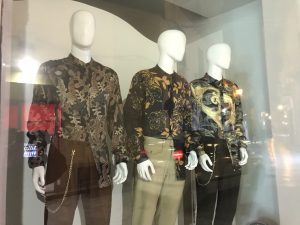
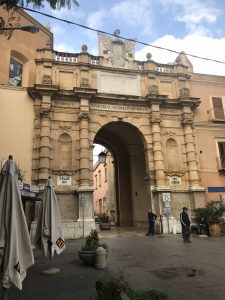
 If you remember those Tuscan Hill Towns with traffic restrictions, well Sicilian historic towns function the same way. There’s a ZTL (Zona Traffico Limitato) where unsuspecting tourist drivers will be automatically ticketed once they enter. Siri leads us directly through Marsala’s and we’re about to drive into the foyer of Dolce and Gabbana’s before I realize our mistake. Next problem – Parking in Centro Storico here is next to impossible, third problem is the Airbnb host doesn’t speak English (first time on this entire trip) so a phone call doesn’t bail us out. Eventually, we park illegally and walk to the apartment where the host has sent someone round to meet us who has a little bit of English and we can be checked-in. The morale of this story being, if you plan to stay in a historic Italian town and have a car, understand exactly where to park and how to get there based on local knowledge not the Internet.
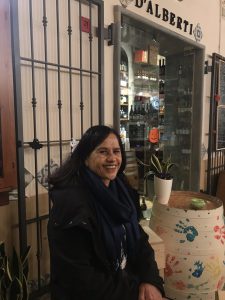
 Marsala is famous for its self-named wine, more later, and sits within Italy’s largest wine growing area, with a famous but small historic center but, overall, we found it to be disappointing. Outside of the immediate center it is heavily depressed, there is a big garbage problem, the waterfront is a disaster of 1970s planning and the unemployment of the local and immigrant young men is obvious to see. Still safe enough though, more so than Western Europe and, absolutely, the USA, sweeping generalizations aside. Don’t know where the corresponding young women were, it was strange.
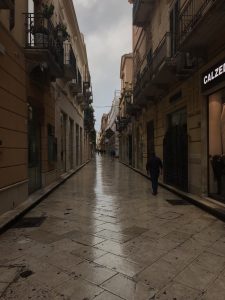 Further, the center is quite glitzy and full of designer stores, quite at odds with the local residents, so if you need a pair of high end boots, you came to the right place. A brief description in a travel guide or webpage will not get to the heart of any place, and that was the case here, so do your itinerary homework carefully.
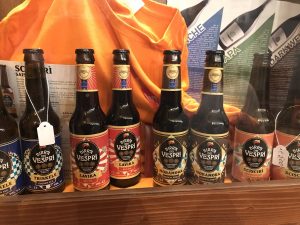
 For all its perceived faults, Marsala is still a great place for wine as, aside from the famous wine named after the place, there are scores of enoteca and osteria selling cheap and good Sicilian wine. If all you’ve tried of Sicilian wine are fat, soft boozy reds you’ll be in for a revelation. Yes, there is Nero d’avola but most are surprisingly structured and balanced, almost elegant and the same goes for the local Syrah. Then they blend in other local grapes like Frappato, Nerello Mascalese and Pinot Nero and you have the start of a real wine party. There are whites too, which we only drank occasionally, but they were also very pleasant.
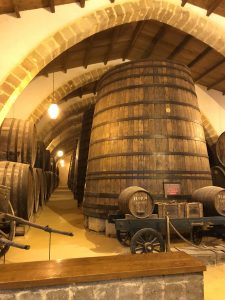
Marsala” wine is a completely different animal. It doesnt feature much in the local cafes but it is also a very big deal. We sign up for a tour of the local fortress “Florio” where Marsala is made and it’s, perhaps, the most unique winery we’ve ever visited. Built like a castle, no cellars, the front door open to let in the humid, salty air, truly enormous wooden barrels. Low lighting, everything else made of the local volcanic “tufa” limestone, a ton of sometimes sleazy history, this place was something else. Given the weather was diabolical it’s just us and a Czech couple with the tour lady and we get an educated earful.
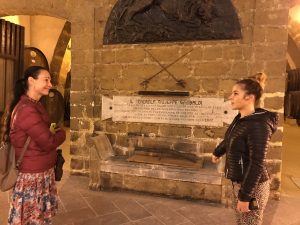 The barrels are open to the marine air and the basic wine is modified by adding aged must (grape juice with skins, seeds and stems) and, at the end of the whole process wine brandy is added to up the alcohol content. Originally, the latter was to allow the wine the capability to survive shipment back to the UK but, these days, it’s to maintain the arcane characteristics of this unique wine type. It comes dry, semi-dry and sweet and, yes, vast quantities of the lower end stuff is made for cooking, but the good stuff is very good indeed as an aperitif.
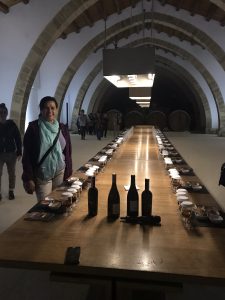
The tasting is craftily staged in a room with discrete lighting, ambient background music and artfully arranged wine and food tasting. Don’t get carried away, it’s only costing us Euro 15 each. Abby’s not a big Marsala fan but is good with the red and white table wines that are included. There’s a group of Japanese ladies in a parallel group (Ohayo Gozaimasu) who are very urbane, but hardly touch the food or wine, though they seem delighted in the esthetics of all it all.
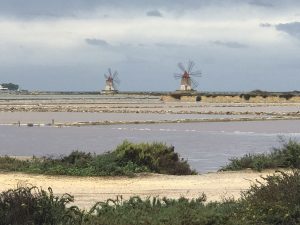 The rain keeps on keeping on but stops for a while for us to take a look at the “Saline” of Trapani, which are high end sea salt beds where artisanal salt is manually harvested. Would have been pretty in the Summer with the decommissioned windmills but we wish we passed on the rustic lunch. OK, we’ve become food snobs but all we’re looking for is a light touch with vegetables and seafood. In Sicilia watch out for gross overuse of salt and lack of much anything green. After you’ve been on the road a long time, these things get to you.
Damn, and now WordPress has switched fonts on me and I’m damned if I can figure out how to fix it, so, continuing, we’re up near Erice, a little hill town perched on the top of a truly awesome slab of a stand alone mountain, but the road up is insane and we’re battle fatigued and so give it a miss and add it to the “maybe next time’ list. Yes, there is such a list and, giveaway, that’s because things pick up for us significantly later in Sicilia.
Was I harsh on Marsala? Actially, I don’t care as we found better places in the rest of our time down here. I realize that tourism itself changes the equation completely but that is a fact of life here. Indeed, tourism is a huge factor in all European historical towns, there’s no way around it. I think the problem in Marsala was the huge imbalance between the pomp and consumerism of the Centro Storico and the “verging on poverty” of the rest of it.
 Well, we’re not likely to be back here but we’re heading onto Cefalu on the Northern Coast which is said to be s sweetheart. We shall see.
Leave a Reply